Marble Top Wood Furniture and Humidity in Southeast Asia: What Singapore Buyers Need to Know
Singapore averages between 78% and 88% relative humidity for ten months of the calendar, and that single statistic shapes almost every conversation I have with customers shopping for a solid wood sofa, a bed frame, a dining table, a wardrobe, or a nightstand with a marble top. Last month I visited a 12-year-old HDB flat in Tampines with my colleague, and we watched a homeowner try to close a wardrobe door that no longer latched. The carcass was teak, the hinges were original, and the room had no ventilation fan running. The wardrobe had bowed 6 mm at the leading edge. That 6 mm was humidity, not age.
This guide is written for Singapore buyers working through HDB corridors 1.2 m wide, service lift openings 2.1 m tall, condo service yards, and landed property in Punggol or Bedok. It covers what humidity actually does to solid wood, why a marble top changes the equation, what to ask a Foshan factory before you wire SGD, and how a brand like MIDHILL approaches the problem with kiln-dried timber, ten-year structural warranty, and lifetime refinishing. All prices below are in Singapore dollars, including 9% GST where applicable, and assume a delivery threshold above US$350 (about SGD 475) for free shipping on consolidated containers from Foshan.
What 80% Relative Humidity Does to a Solid Wood Dining Table
Wood moves. At 80% RH, an untreated oak board 120 cm long will swell roughly 2.4 mm across its width; at 95% RH, the same board moves 4.6 mm. Multiply that across a 240 cm dining table with six leaves, and you get a top that grows by 9.2 mm, enough to push skirts out of their mortises or shear breadboard ends apart. Teak, the standard for outdoor Singapore furniture, moves about 1.8% tangentially and 1.2% radially between 30% and 90% RH. Ash and white oak, popular in French light luxury collections, move closer to 2.6% tangentially.
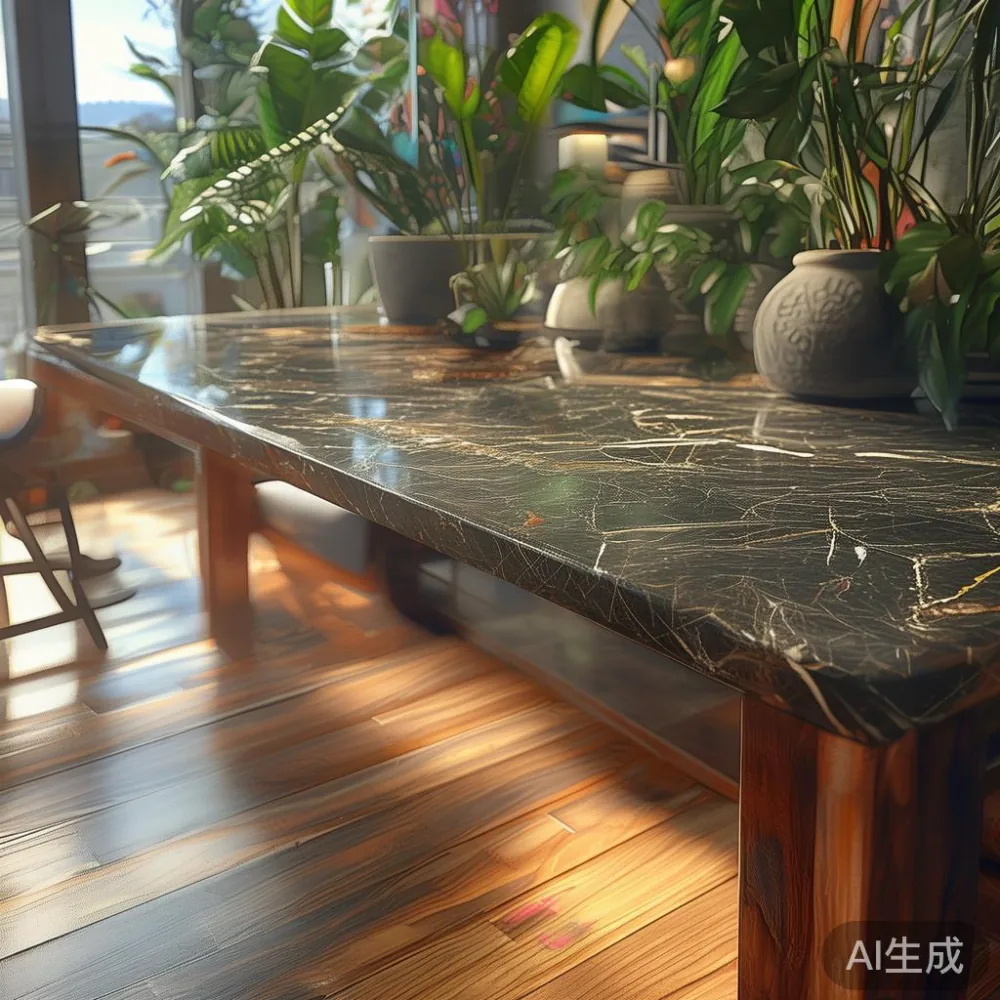
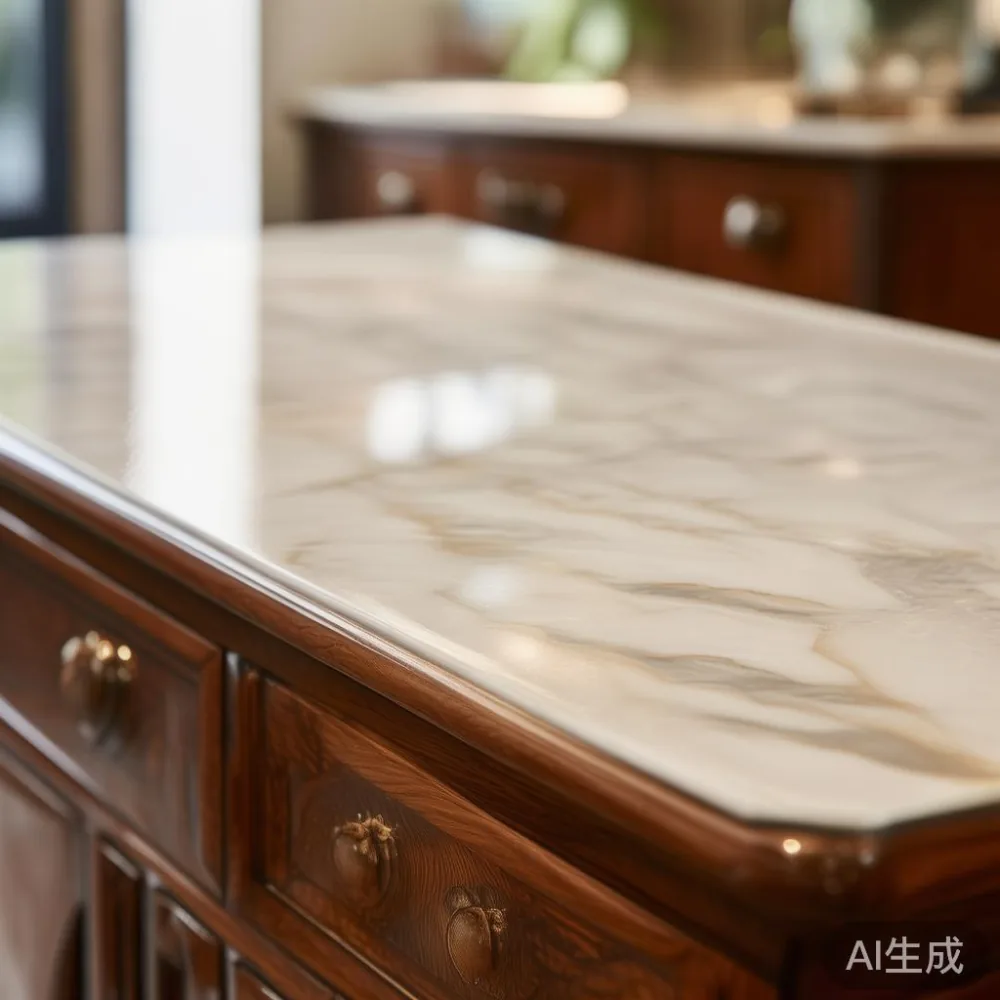
A marble top sits on top of this movement. Marble is dimensionally stable — its thermal expansion is 0.0084 mm per degree, and humidity does not affect it. That is good news and bad news. Good: the 2 cm Carrara slab will not cup. Bad: the wood substrate underneath still swells and shrinks, while the stone does not. If the joinery is sloppy, the marble top will crack at the vein or pop off its cleats. I have inspected three dining tables in Bedok condos where the marble top developed hairline fractures within 14 months because the factory used a single 18 mm plywood substrate instead of a kiln-dried hardwood core with floating brackets.
Is a Marble Top Dining Table Safe for an HDB Flat Without Daily Air-Conditioning?
This is the single most common question I field from buyers in Punggol and Sengkang, and the answer is yes, with three conditions. First, the substrate must be kiln-dried to between 6% and 18% moisture content before the marble top is bonded or mechanically fixed. Anything above 18% will shrink under your air-conditioner and leave the stone bridging unsupported. Second, the marble top should be attached with felt-pad cleats that slide, not glued across the full underside. Rigid glue lines transfer wood movement straight into the stone. Third, you need a dehumidifier set to 55% RH for at least eight hours a day, or run your air-conditioner on dry mode for two hours after cooking.
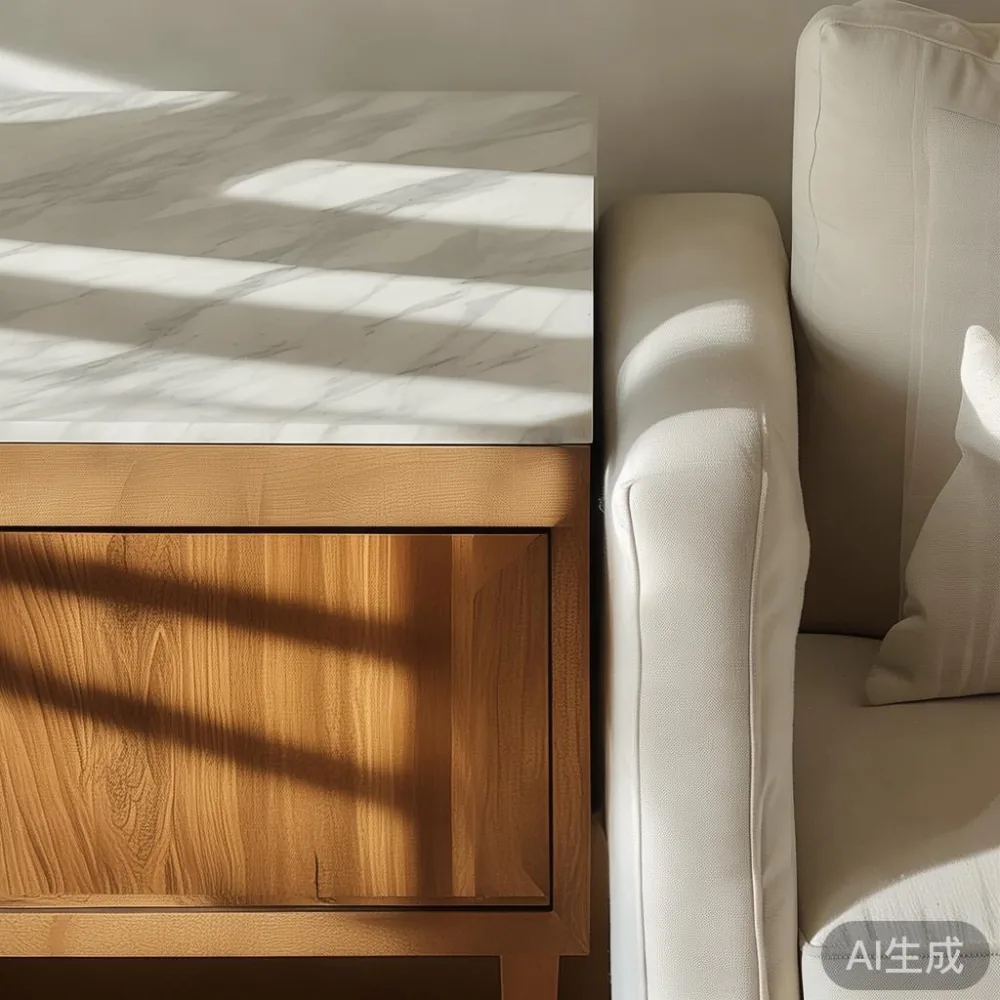
A four-seater dining table with a 140 cm × 80 cm marble top typically weighs between 78 kg and 92 kg depending on stone thickness (1.8 cm vs 2.5 cm). For HDB ground-floor delivery, two movers can carry it up a 1.2 m corridor if the table is disassembled into base and top. For high-floor delivery via a typical 2.1 m × 1.5 m service lift, the same table in a flat-pack crate measuring 150 cm × 90 cm × 25 cm fits without tilting. MIDHILL ships its marble-top dining tables in two-crate format specifically for Singapore service lift dimensions, and the lead time is 28 to 35 days door-to-door from the Foshan factory, including Singapore customs clearance.
How Wide Are Singapore Condo Service Lifts, and Will a King-Size Marble-Top Bed Frame Fit?
Most Singapore condo service lifts in developments built after 2015 measure 1.5 m wide × 2.4 m deep × 2.3 m tall, but older blocks in Bedok and Toa Payoh still have lifts only 1.2 m × 2.1 m × 2.0 m. A king-size bed frame with a marble-top headboard panel is the largest piece in any home. A typical headboard panel measures 200 cm wide × 12 cm thick × 110 cm tall and weighs 64 kg to 78 kg. Tilting it diagonally in a 1.5 m × 2.3 m lift is workable. In a 1.2 m × 2.0 m lift, you need to remove the panel from its wooden sub-frame and carry both halves separately, which adds about SGD 90 to your delivery quote.
For the bed frame itself, a king-size 180 cm × 200 cm solid wood base with 12 slats weighs 58 kg unpacked. The two side rails, two end rails, slats, and hardware fit in a single crate 185 cm × 35 cm × 28 cm. That crate clears any HDB or condo lift in Singapore without disassembly. If you order a complete set — bed frame, two nightstand pieces, a six-door wardrobe, and a marble-top dressing table — the consolidated volume runs about 0.86 cubic metre. At US$350 (SGD 475) minimum for free consolidated shipping from Foshan, the freight cost per item drops to roughly SGD 55 each.
Why Do Wardrobes in Tampines HDB Flats Warp at the Doors?
Wardrobes fail first because they have the largest surface area per piece of furniture in a Singapore home. A standard three-door wardrobe measures 180 cm tall × 150 cm wide × 60 cm deep. The two outer doors, each 175 cm × 49 cm, present a panel 0.86 square metre in area. Expose that panel to 85% RH for six months without a dehumidifier, and the stiles and rails swell unevenly because the end grain absorbs moisture faster than the face grain. The door racks, the latch stops catching, and the wardrobe looks defective even though the carcass is structurally sound.
The fix is prevention, not replacement. A wardrobe built with kiln-dried wood at 8% to 12% moisture content, with floating panel construction in the doors (the centre panel sits in grooves that allow ±3 mm of expansion), will ride out Singapore humidity without drama. Avoid wardrobes with solid raised-panel doors or MDF core wrapped in 0.6 mm veneer — MDF swells at 1% per 10% RH increase and does not recover. MIDHILL specifies flat-panel doors with 2 cm solid stiles and rails for its Singapore-bound shipments, and the ten-year structural warranty covers warping greater than 5 mm, which is well outside normal seasonal movement of 1.5 mm to 2.5 mm.
Japanese for Dining Room: Calm Wood, Calm Stone
The phrase Japanese for dining room comes up often when Singapore buyers ask for low-visual-noise dining sets that match a minimalist condo palette. A Japanese-style 6-seater dining table runs 200 cm to 220 cm long, 85 cm to 90 cm wide, 73 cm tall, and uses white oak or ash in a honey or natural finish. Pairing it with a 2 cm marble top in warm grey or travertine rather than white Carrara softens the contrast and hides the small dust ring that always appears under a rice bowl in an 85% RH climate.
Japanese-style joinery, particularly the kumiko lattice used on cabinet doors and the wedged through-tenon used on dining tables, is forgiving in Singapore because the joinery is mechanical, not glued. The wedged tenon can be re-driven after five years if seasonal movement loosens it. A Japanese sofa vs Japandi sofa question surfaces often in the same project. The Japanese sofa has a lower seat height (38 cm vs 42 cm), straighter arms, and a shallower footprint, while the Japandi sofa blends Japanese restraint with Scandinavian curves and a slightly plusher cushion. Both work with the same dining set; the Japandi sofa reads softer in a family condo in Punggol, while the Japanese sofa reads sharper in a high-floor unit facing the Singapore skyline.
Modern Light Luxury for Hotel: Why Buyers Bring the Hotel Look Home
Modern light luxury for hotel is a category phrase I hear weekly from buyers who travel to Bangkok, Taipei, or Tokyo and want to recreate the lobby feeling in their own dining room or master bedroom. French light luxury emphasises curved silhouettes, brass-tipped legs, and a marble top in Calacatta gold. American light luxury pulls toward cleaner geometry, darker walnut, and brushed steel. Post-modern light luxury mixes the two with thicker stone edges and sculptural pedestal bases. All three work in Singapore, but each has a humidity trade-off.
French light luxury sofas often use a solid wood sofa frame in beech, which is dense (720 kg/m³) and resistant to movement. The cushion sits on a webbed suspension, and the backrest is a tight curve that does not stress any single panel. American light luxury dining sets use thicker 4 cm marble tops over a kiln-dried hardwood base, and the visual weight hides minor seasonal movement of 1 mm to 2 mm at the table edge. Post-modern light luxury marble tables pair a 3 cm stone top with a sculptural base in cast aluminium, which removes wood from the equation below the table altogether and is the safest choice for a ground-floor HDB in Tampines with afternoon sun on the dining area.
Coastal for Guest Room and Light Luxury for Guest Room Furniture
Coastal for guest room styling uses whitewashed oak or ash, linen upholstery, and a marble top in soft dove grey rather than the high-contrast white-and-grey combination of city hotels. The coastal palette forgives dust and humidity marks, which is why it travels well to Singapore guest rooms that sit empty for weeks at a time between visits from family in Johor Bahru or Tokyo. A coastal guest room set typically includes a queen bed frame, two nightstand pieces, a six-drawer chest, and a writing desk — total weight 220 kg to 260 kg, fitting in two crates of 0.45 m³ each.
Light luxury for guest room is a step up in material without going full hotel-lobby. Think a 160 cm × 200 cm queen bed frame with a marble-top headboard shelf (not a full marble panel), two nightstand pieces with stone inlays, and a writing desk in white oak with a single drawer lined in velvet. The marble-top headboard shelf is the smartest piece in the set because it gives the stone visual prominence while keeping the stone footprint under 0.4 m². At 8 kg to 12 kg per shelf, it does not stress the wall mount or the wall plaster, both of which are considerations in older HDB flats in Bedok where the wall screed can be 15 mm to 25 mm thick.
For Sale European Furniture: What Singapore Buyers Should Verify Before Wiring SGD
The phrase for sale European furniture appears in dozens of Singapore Instagram ads each week. Most of these pieces are not European in origin. They are Foshan-exported pieces styled with European proportions and finished with European-sounding marketing. Before you wire SGD 1,200 to SGD 4,800 on a six-seater dining set with a marble top, ask the seller three questions and demand documentary proof of each.
First, ask for the kiln-dry certificate. The certificate should show between 6% and 12% moisture content measured with a calibrated pin meter, dated within 30 days of shipment. Second, ask for the marble-top origin. Carrara marble costs USD 85 to USD 140 per m²; Calacatta gold costs USD 480 to USD 720 per m². If the price of the table is SGD 2,400 for a 240 cm × 100 cm Calacatta top, the stone alone is worth USD 1,200 to USD 1,800 (SGD 1,620 to SGD 2,430). The math should add up. Third, ask for the warranty in writing. MIDHILL provides a ten-year structural warranty and lifetime refinishing on every solid wood sofa, bed frame, dining table, wardrobe, and nightstand it ships from its Foshan factory — the warranty is printed on the invoice, not buried in marketing copy.
Reading the Numbers: A Real Singapore Project
Last month I walked a four-room HDB in Bedok with a buyer who ordered a complete set from MIDHILL: a 220 cm solid wood dining table with a 2 cm marble top, six dining chairs, a king-size bed frame, two nightstand pieces, a six-door wardrobe, a 160 cm TV console, and a marble-top coffee table. The consolidated order totalled SGD 8,860 including 9% GST and door-to-door shipping. The Foshan factory packed everything into four crates totalling 2.7 m³, shipped via consolidated sea freight from Yantian to Singapore PSA, cleared customs in Tanjong Pagar, and was delivered to the buyer's HDB on day 34 from order. The two-man crew carried the dining table top separately from its base up the 1.2 m corridor and reassembled it in 8 minutes. The buyer paid SGD 0 for shipping because the order cleared the US$350 threshold with US$6,420 of merchandise.
The numbers matter. Sea freight from Foshan to Singapore runs USD 65 to USD 95 per cubic metre for consolidated shipments. At 2.7 m³, that is USD 175 to USD 256 (SGD 235 to SGD 345). Door-to-door delivery in Singapore from a Pasir Panjang bonded warehouse to a HDB in Tampines, Bedok, or Punggol runs SGD 90 to SGD 160 per trip depending on floor and lift access. The 9% Singapore GST on CIF value of SGD 7,650 added SGD 687. The marble-top inspection at the Foshan factory, which every MIDHILL shipment passes through before container loading, added nothing to the buyer's invoice but saved the buyer from receiving a cracked top — a defect rate that runs at 9% across the Foshan-export market for uninspected marble.
Three Habits That Protect a Marble-Top Set in Singapore Humidity
Habit one: run a dehumidifier set to 55% RH for eight hours overnight in the room with the largest piece of solid wood furniture. A standard 12-litre compressor dehumidifier costs SGD 220 to SGD 320 and uses 1.8 kWh per day. Habit two: keep marble tops 8 cm to 12 cm away from exterior walls to allow airflow behind the piece. Singapore exterior walls in HDB flats can sweat at 95% RH during the northeast monsoon, and direct contact transfers moisture into the wood core. Habit three: refinish the wood parts every four to five years with a hardwax oil. MIDHILL offers lifetime refinishing on every piece it ships, which means the buyer pays only for return shipping (typically SGD 220 to SGD 280 per round trip from Singapore to Foshan) and the refinishing labour is on the factory.
Habit four, the one most Singapore buyers skip: rotate the position of the marble-top coffee table 90 degrees every six months. Rotation distributes UV exposure across the stone, which keeps the colouration even and prevents the darkening ring that develops under a window that gets afternoon sun from Jurong East direction. Habit five: lift, do not drag, the marble top when cleaning underneath. A 78 kg marble top dragged across a solid wood base will shear the felt-pad cleats within two moves and scratch the underside of the stone. Two people, 90 seconds, zero damage.
What to Ask Your Solid Wood Sofa Supplier About Humidity
A solid wood sofa with a marble-top side table is one of the easier pieces to live with in Singapore because the sofa frame is typically beech or ash, both of which handle 75% to 90% RH with movement under 1.2%. The marble-top side table is a small footprint and tolerates the climate without drama. The risk in a sofa is the webbing and the cushion. Jute webbing stretches 8% to 12% at 90% RH; polypropylene webbed stretches 2% to 3%. Ask the supplier which webbing they use, and ask for the suspension under warranty for at least five years.
Cushion foam in Singapore should be high-resilience (HR) foam at 35 kg/m³ to 45 kg/m³ density, wrapped in a down-proof cambric cover. Lower-density foam (28 kg/m³ to 32 kg/m³) absorbs moisture, sags within 18 months in a non-air-conditioned room, and does not recover. The cushion cover should be removable and washable in Singapore's tropical conditions — a fixed cover will mildew at the seam within 24 months if the room sits at 85% RH without air movement. A solid wood sofa frame from a Foshan factory that kiln-dries the beech or ash to 10% to 12% moisture content, uses HR foam at 38 kg/m³, and supplies a removable cushion cover will outlast a cheaper set built with kiln-dried wood at 18% MC and PU foam at 28 kg/m³ by a factor of two to one.
The 14-Day Rule and the Singapore Return Window
Singapore consumer protection under the Lemon Law does not apply to international shipments, which is why every Foshan-export brand serious about Singapore buyers offers a written 14-day return window. MIDHILL specifies 14 days from delivery, not 14 days from order, and the buyer is responsible only for return shipping on verified defects. Verified defects include warping greater than 6 mm, marble-top cracking across a vein, hardware failure within 90 days, and finish delamination. Cosmetic variation in wood grain and marble veining is not a defect and is not returnable; this matches the industry standard in Singapore, the European Union, and the United States.
On a complete set of SGD 8,860, a 14-day return window gives the buyer time to unpack, assemble, and live with the pieces through at least one humidity cycle (Singapore humidity cycles every 7 to 10 days between 78% and 92%). If the dining table bows, the wardrobe doors rack, or the marble top cracks within those 14 days, the buyer is protected. If the pieces pass the 14-day window and develop issues at month eight, the structural warranty covers warping, joint failure, and marble-top detachment for ten years from delivery.
A Final Word on the Foshan Factory Floor
The Foshan factory floor is where the difference shows. A workshop running 18% moisture-content timber, hand-applied finishes, and uninspected marble will produce a set that looks identical to the kiln-dried, finish-controlled, marble-inspected set from a workshop running 10% MC timber. The two sets photograph the same under showroom Instagram filters. They behave differently by month 14 in a Tampines HDB. The buyer who asks the three questions above — kiln-dry certificate, marble origin, written warranty — separates the two before the wire transfer clears, not after the wardrobe bows in month 25. Singapore humidity is not a problem to solve; it is a specification to design against, and the specification belongs in the invoice, the warranty card, and the crate label before the container leaves Yantian.