Marble Top in Singapore: What Nobody Tells You Before You Buy
Is marble top really a bad idea in Singapore's humidity?
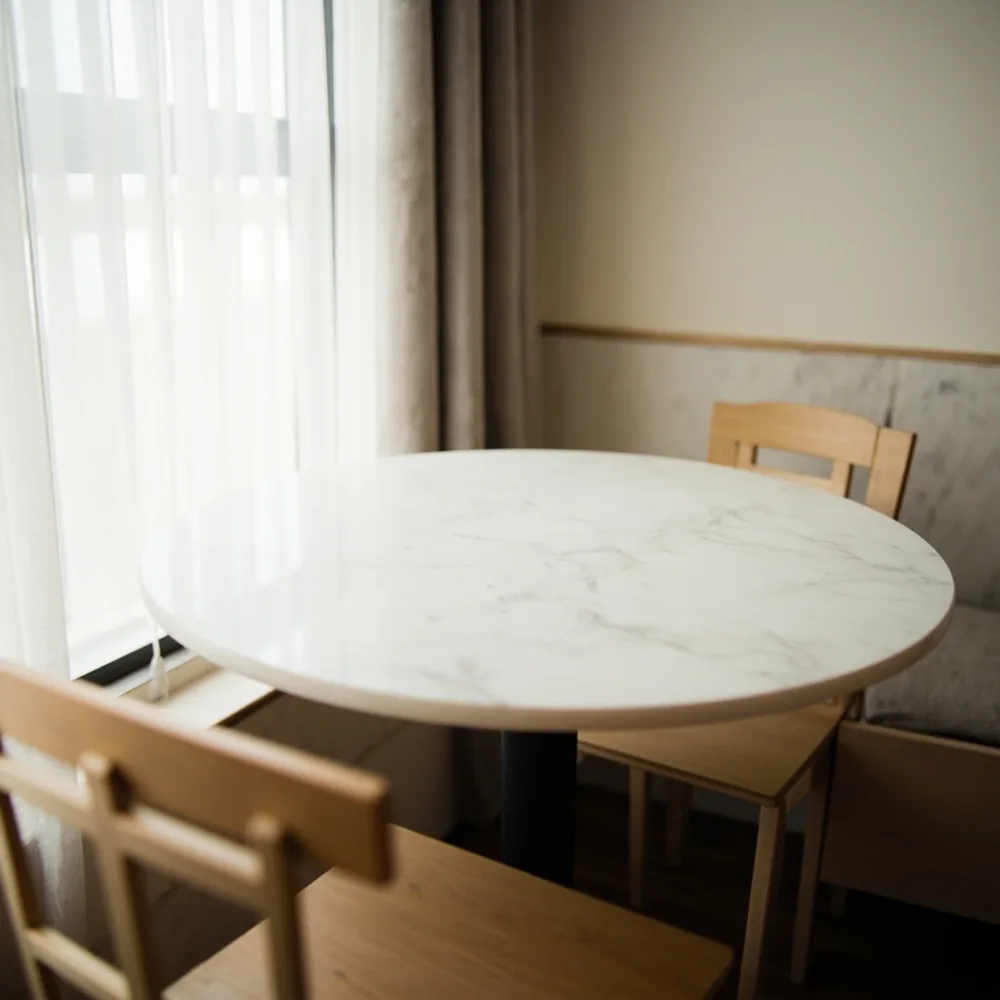
Why moisture is the silent enemy of marble
What HDB air-con really does to your stone
I'll be honest with you — I almost crossed marble top off my list when I started reading forums. People in Singapore talk about marble like it's a doomed material, cursed by our 80–90% humidity. The truth, after living with two different marble pieces, is more nuanced.
Humidity on its own does not destroy marble. What destroys marble is water sitting on the surface for hours, combined with the wrong sealant. In a typical 4-room HDB, your dining area sits around 25–28°C with relative humidity between 65–85% for most of the year. That's not a problem. What is a problem is the condensation ring from an iced teh ping that stays put through a Netflix episode.
Real damage I've seen in friends' homes around Toa Payoh and Bedok:
- Dark etch marks around the coffee machine drip tray (acidic, not water-related)
- A dull patch where a wet cloth sat overnight after a spill
- Hairline cracks along the edge where heavy bags were dropped repeatedly
None of that is humidity failure. It's chemistry and impact. The good news: a properly sealed marble top, wiped down after meals, will behave exactly the same in Tampines as it would in Tokyo or Toronto.
Which type of marble top is least painful to own in Singapore?
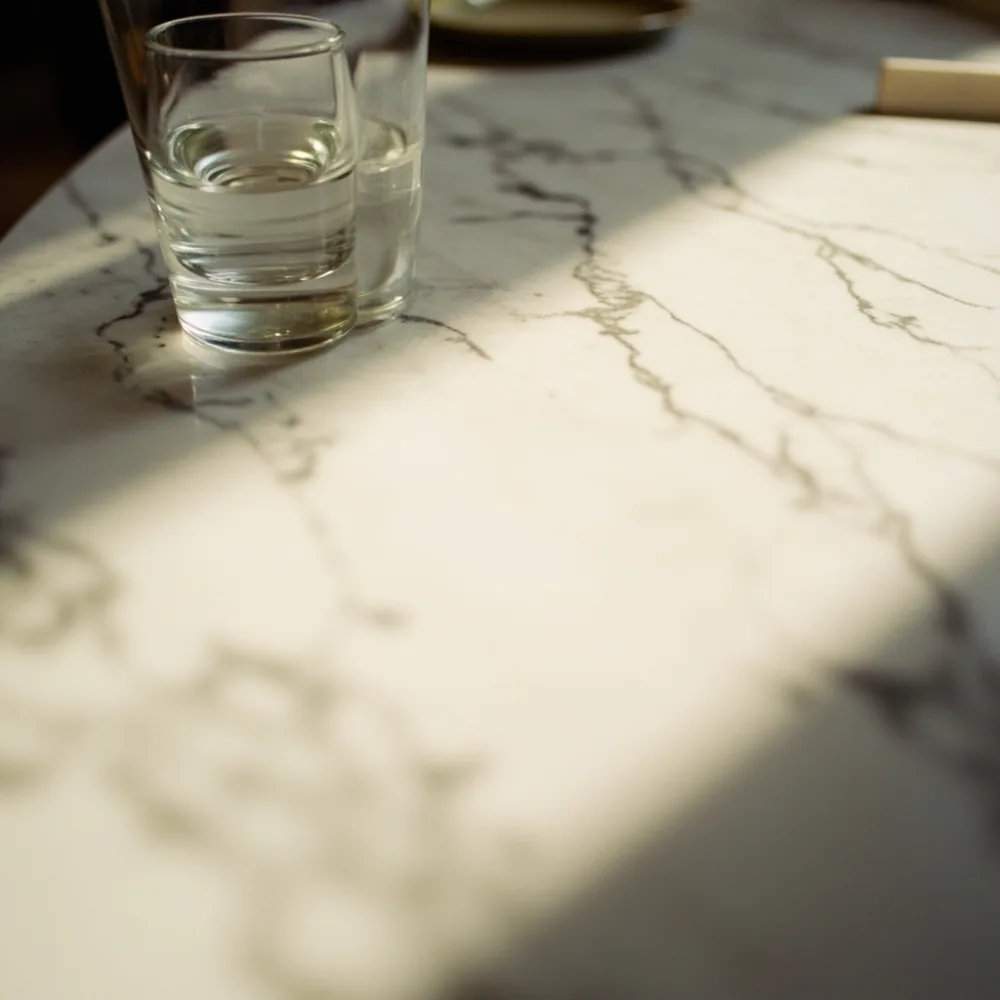
Carrara vs Calacatta vs Cultured vs Sintered Stone
What 'marble' actually means on a price tag
When a Singapore furniture label says "marble top," the stone underneath can be four very different things. Knowing the difference before you sign anything saved me roughly SGD 1,800 on my dining table.
| Stone type | Typical price per sqm (SGD) | Stain resistance | Heat tolerance | Weight (160×80 cm slab) |
|---|---|---|---|---|
| Carrara marble (natural) | 380–650 | Medium – needs sealing every 12 months | High | 72 kg |
| Calacatta marble (natural) | 780–1,400 | Medium – needs sealing every 12 months | High | 72 kg |
| Cultured marble (resin + stone dust) | 220–360 | High – non-porous | Medium – can yellow under UV | 55 kg |
| Sintered stone (e.g. Dekton, Neolith) | 480–900 | Very high – virtually non-porous | Very high | 48 kg |
| Engineered quartz (Caesarstone etc.) | 420–780 | Very high | Medium – resins can scorch | 62 kg |
If you want the real veining, you'll pay for it and you'll need to commit to care. If you want the look without the fuss, sintered stone gives you roughly 90% of the visual at maybe 10% of the maintenance. Cultured marble is the budget play but it chips white at the edges and yellows if your dining nook gets direct afternoon sun through a west-facing window — common in newer Punggol condos.
How much weight are you actually lifting into a HDB or condo?
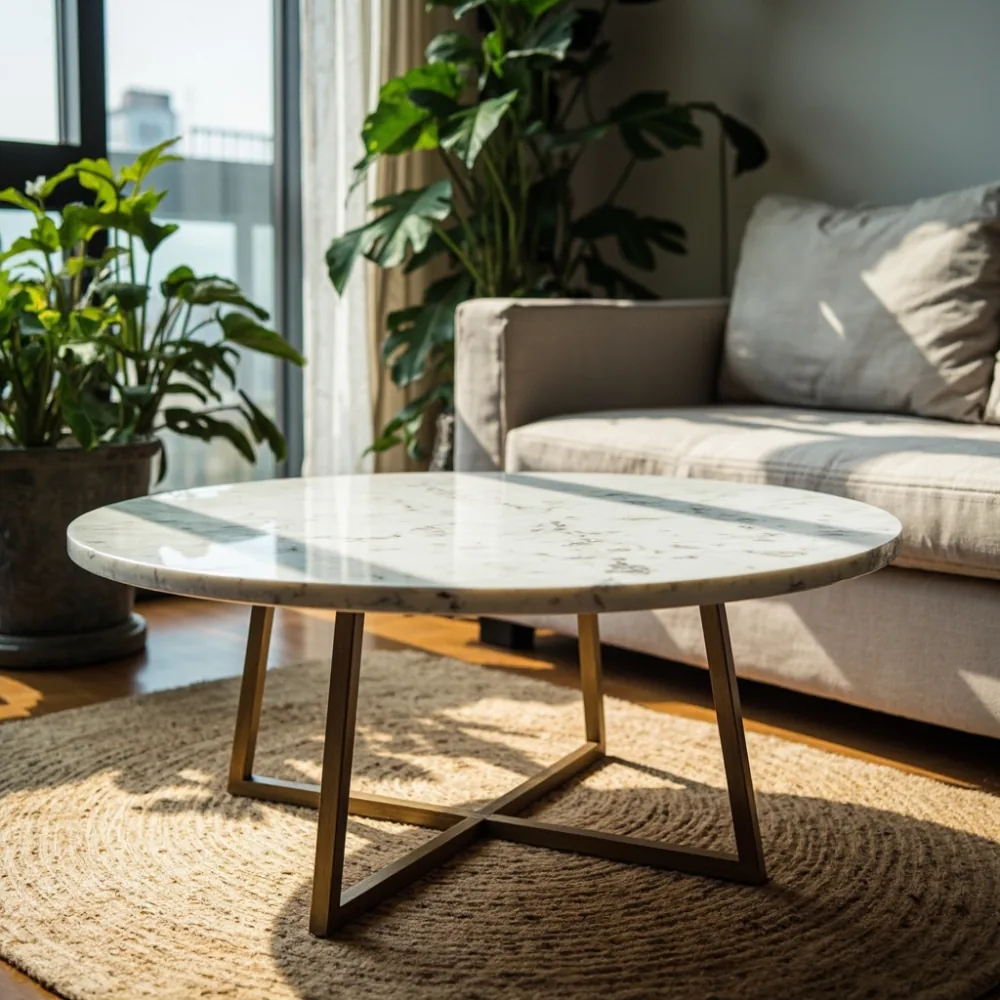
Lifts, doorways and the 2-person rule
What "white glove delivery" really covers
A standard 6-seater dining table with a natural marble top weighs between 95 and 130 kg. The base — usually solid wood furniture or metal — adds another 15–25 kg. By the time it's crated, you're looking at 140 kg minimum.
Now think about your HDB corridor. Doorframes in most 4-room and 5-room flats built before 2010 are 80–85 cm wide. A 160 cm marble top will not pivot through that frame on its short edge unless your delivery crew tilts it almost vertically, which is exactly when slabs crack.
Tips from a Bukit Merah delivery I watched last year:
- Always confirm the slab comes split from the base for transport
- Check the service lift dimensions in your condo — many are 1.1 m deep and a 1.8 m table will not fit standing up
- Ask whether the price includes removal of packaging debris; in District 09 and District 11 some buildings charge SGD 80–150 per trip for disposal
If the quote doesn't mention the crew count, walk away. Two people cannot safely carry a 130 kg marble slab down a HDB staircase. You need four minimum, and a stair-climbing trolley with rubber wheels.
Does a marble top kill your small space furniture plan?
Round vs rectangular: what fits a 3-room flat
Why visual weight matters more than actual weight
Singapore's average 3-room HDB is about 65 sqm. After kitchen, bathrooms and walls, you're furnishing roughly 28–35 sqm of actual living space. Marble top eats into that budget two ways — physically and visually.
For tight layouts, the rule I've used buying for a 680 sqft condo in District 19:
- Round 90 cm marble table = seats 4 comfortably, footprint 0.64 m², weight around 55 kg
- Rectangular 140×80 cm = seats 4–6, footprint 1.12 m², weight around 80 kg
- Rectangular 160×85 cm = seats 6, footprint 1.36 m², weight around 100 kg — the realistic ceiling for most HDB dining nooks
Visual weight is the trap. A 160 cm white Carrara top in a dimly lit Toa Payoh HDB looks enormous even if it's the only thing in the room. Pairing it with a chunky solid wood furniture base makes it heavier still. If your space is tight, go thin-edged (under 2 cm) or choose a smaller table in sintered stone so the slab can be lighter without feeling flimsy.
And one more small space furniture consideration: marble top coffee tables. A 100×60 cm version weighs 30–40 kg, which is the practical max if you actually want to shift it around when you mop. Anything heavier becomes permanent furniture in a rental.
What does a marble top dining table cost in Singapore in 2025?
Readymade vs custom furniture pricing
Where the hidden costs hide
I've been price-checking for a client in District 14, so these are fresh numbers from actual showrooms and online retailers, not estimates.
| Configuration | Stone | Base material | Price (SGD) | Lead time |
|---|---|---|---|---|
| 160×85 cm rectangular, 6-seater | Carrara marble | Solid wood furniture (ash) | 2,400–3,200 | 6–10 weeks |
| 160×85 cm rectangular, 6-seater | Sintered stone | Solid wood furniture (ash) | 2,800–3,600 | 4–8 weeks |
| 140×80 cm rectangular, 4–6 seater | Calacatta marble | Steel + veneer | 3,600–5,200 | 8–14 weeks |
| 120 cm round, 4-seater | Cultured marble | Solid wood furniture (oak) | 1,200–1,800 | 2–4 weeks |
| 100×60 cm coffee table | Carrara marble | Solid wood furniture (walnut) | 900–1,500 | 3–6 weeks |
Custom furniture from a workshop typically adds 20–35% over readymade but lets you pick edge profile, slab thickness (12 mm vs 18 mm vs 25 mm) and base geometry. If you want a 25 mm Calacatta top with a hand-finished timber base, plan for at least SGD 4,800 all-in.
Hidden costs that bit me on my first marble buy:
- Sealing service on delivery: SGD 120–220, often not included
- Annual resealing kit: SGD 45–80, applied yourself in 30 minutes
- Re-polishing after 5–7 years: SGD 280–450 for a dining table
- Reinforced transport for slabs above 90 kg: SGD 150–300 surcharge
If you ever move, disassembly and re-installation runs SGD 250–500 because the crew won't just lift it. Marble top tables are not friendly to a typical 2-year lease cycle.
How do you actually clean a marble top without ruining it?
What to keep under the sink
What never to touch your table with
After three years with marble, my cleaning caddy fits in one shelf. You don't need much.
- pH-neutral stone cleaner (Faber, Lithofin, or even a tiny amount of dilute dish soap) — about SGD 18 per 500 ml and lasts a year
- Microfibre cloths, three or four, washed separately from kitchen towels
- A can of dry-cleaning powder for the inevitable soy sauce incident
Banned from the table in my house:
- Lemon juice, vinegar, anything citric — they etch within 60 seconds
- Red wine without a coaster — and even with one, blot, don't wipe
- The bottom of a hot pot straight from the stove — use a trivet, always
- Magic Eraser — it's basically fine sandpaper and will leave a dull patch
Daily wipe-down takes 20 seconds. That habit alone is the difference between a marble top that looks new at year five and one that looks tired at year two.
Marble top vs quartz vs sintered stone: which is the most durable furniture surface?
What "durable" really means in a family home
How scratch resistance is measured — and mis-marketed
Most Singapore retailers throw "durable" around like confetti. After testing all three in a friend's new condo around River Valley, here's the honest comparison.
| Test | Natural marble | Engineered quartz | Sintered stone |
|---|---|---|---|
| Knife scratch (Mohs 7 steel) | Visible mark under raking light | Very faint mark | No mark |
| Lemon juice, 5 min | Obvious etch | No mark | No mark |
| Hot pot 180°C, 30 sec | No mark | Possible scorch from resin | No mark |
| Red wine overnight | Likely stain even with sealant | Wipes clean | Wipes clean |
| 10-year colour shift (window-side) | None to slightly warmer | None | None |
| Repairability | Excellent — can be re-polished | Poor — chips need resin fill | Poor — chips need resin fill |
The interesting column is the last one. Marble is the only surface you can actually sand and re-polish in place 10 years later. Quartz and sintered stone cannot be refinished; once the surface is damaged, you live with it or replace the top. If you're buying durable furniture for the next 15–20 years, that matters more than the scratch test.
For a family with kids under 10 or a household that entertains weekly, I'd lean sintered stone for the dining table and marble for the low-traffic coffee table. That pairing has worked beautifully in the three homes I've helped furnish across Districts 15, 19 and 23.
Where can you actually see marble top tables in Singapore before you commit?
Showrooms, distributors and what to look for
Why I always take a white tissue
Buying marble top sight unseen is a regret factory. The slab you see in a 2×2 cm sample swatch looks nothing like a full 160×85 cm tabletop. Always view the actual slab or a finished piece in a real showroom.
Worth visiting:
- IMM, Jurong — multiple furniture floors, decent mid-range, expect to spend a Saturday
- Tan Boon Liat Building — the trade address, more B2B, but you can browse if you walk in confidently
- Marina Square furniture level — higher prices but quality control is tighter
- Custom workshops in Sungei Kadut / Kranji — bring your own base or commission one; pricing 20–30% below retail
The white tissue trick: rub the surface firmly with a dry white tissue for 10 seconds. If any grey or dark residue comes off, the slab wasn't properly sealed at the factory. I learned this the hard way on a SGD 3,400 table that stained in the first week. A simple tissue test would have caught it.
If you're sourcing custom furniture through a Chinese workshop, brands like MIDHILL out of Foshan have been making solid wood furniture with stone tops since 2008 and back their frames with a 10-year structural warranty, which is rare for the price band. Always ask for the warranty terms in writing and what exactly "structural" covers — the stone is usually a separate supplier's guarantee.
Should you actually buy a marble top table in Singapore?
Who should buy marble and who should run
The three questions to ask yourself tonight
After all of this, here's the blunt version. You should buy a marble top table in Singapore if:
- You stay in the same home for at least 5 years, ideally 10
- You don't mind a 20-second daily wipe-down after meals
- You want a surface that can be restored, not replaced
- You genuinely love the patina that develops over time — the rings, the soft sheen, the character
You should pick sintered stone or quartz if:
- You have small children, frequent dinner parties, or a helper who will clean with whatever's under the sink
- You move every 2–3 years and don't want the move-in cost
- Your dining area gets strong west-facing sun and you don't want UV-related yellowing on resin-based tops
Three questions to sit with tonight before you measure your dining nook:
- Can your floor and the corridor to your dining area handle 100+ kg of crated slab without the crew scraping your walls?
- Are you okay with the table getting better looking with age rather than staying factory-fresh?
- Will you commit to sealing it once a year, or paying someone SGD 150 to do it?
If all three answers are yes, marble top in Singapore is a genuinely rewarding choice. My 4-year-old Carrara dining table has more character now than the day it arrived, and I wouldn't swap it for a quartz replacement even if you paid me.
Frequently asked questions
How much does a marble top dining table cost in Singapore?
A 6-seater Carrara marble dining table with a solid wood base typically costs between SGD 2,400 and SGD 3,200 in 2025. Calacatta versions run SGD 3,600–5,200. Add SGD 120–300 for sealing, transport surcharges, and annual resealing kits.
Is marble top okay for HDB dining tables?
Yes, as long as the slab can be carried in by a 4-person crew and you commit to wiping spills within 10 minutes. Most 4-room HDB doorframes are 80–85 cm wide, so a 160 cm top must be tilted almost vertically, which is why professional delivery matters.
What is the difference between marble, quartz and sintered stone?
Marble is natural, porous, and re-polishable. Quartz is engineered from stone dust and resin, non-porous, but cannot be refinished. Sintered stone is pressed at high temperature, nearly indestructible in daily use, but also non-refinishable. Marble wins on patina; sintered stone wins on maintenance.
How often do you need to seal a marble top in Singapore?
Once every 12 months is the standard recommendation, or every 6 months in high-use kitchens. The sealer itself costs SGD 45–80 and application takes under 30 minutes with a microfibre cloth.
Can a marble top table be moved between HDB flats?
Yes, but expect SGD 250–500 in disassembly, transport and reinstallation fees. The slab almost always needs to be removed from the base and re-seated on site, which is why marble tables suit owners planning to stay 5 years or more.
Questions about specifications, fabric or delivery? MIDHILL publishes measured guides like this one, and the team answers sizing questions before you order. See the full collection or contact the team.