Veneer vs Solid Wood: A 5-Year Cost Reality Check for Singapore Homes With Marble-Top Furniture
Last month I visited a friend's newly renovated 4-room HDB in Punggol Waterway Terraces, and the conversation drifted to a question I hear every week from shoppers scrolling through Taobao, Shopee, and local ID forums: is the cheaper veneered dining table actually cheaper once you stretch the math over five years? I sat on her solid oak dining chair, ran my hand across a marble-top sideboard, and decided to write this piece for anyone staring at two very similar-looking price tags in a Tampines furniture showroom.
This article is written for Singapore households — HDB flats in Bedok, BTOs in Tengah, and 1,200 sqft condos around Punggol — where humidity sits at 80% year-round, lift doors measure roughly 90 cm wide, and every dollar is multiplied by the 9% GST at checkout. I will keep the math in SGD, the widths in cm, and the rooms realistic. Along the way I will touch on a solid wood sofa, a bed frame, a dining table, a wardrobe, a nightstand, and of course the marble-top pieces that anchor a French light luxury or post-modern light luxury scheme.
What does "veneer" actually mean on a Singapore price tag?
Veneer is a 0.3 mm to 2 mm slice of real wood glued onto a substrate — usually MDF, plywood, or particleboard. A 1.4 m six-seater dining table in rubberwood veneer on MDF retailing at S$899 looks identical to a S$1,950 solid oak version in a 1,400-square-foot condo in Bedok. The substrate is heavier (often 28–35 kg versus 22 kg for solid rubberwood of the same size), and the finish is usually a thin melamine or PU coat.
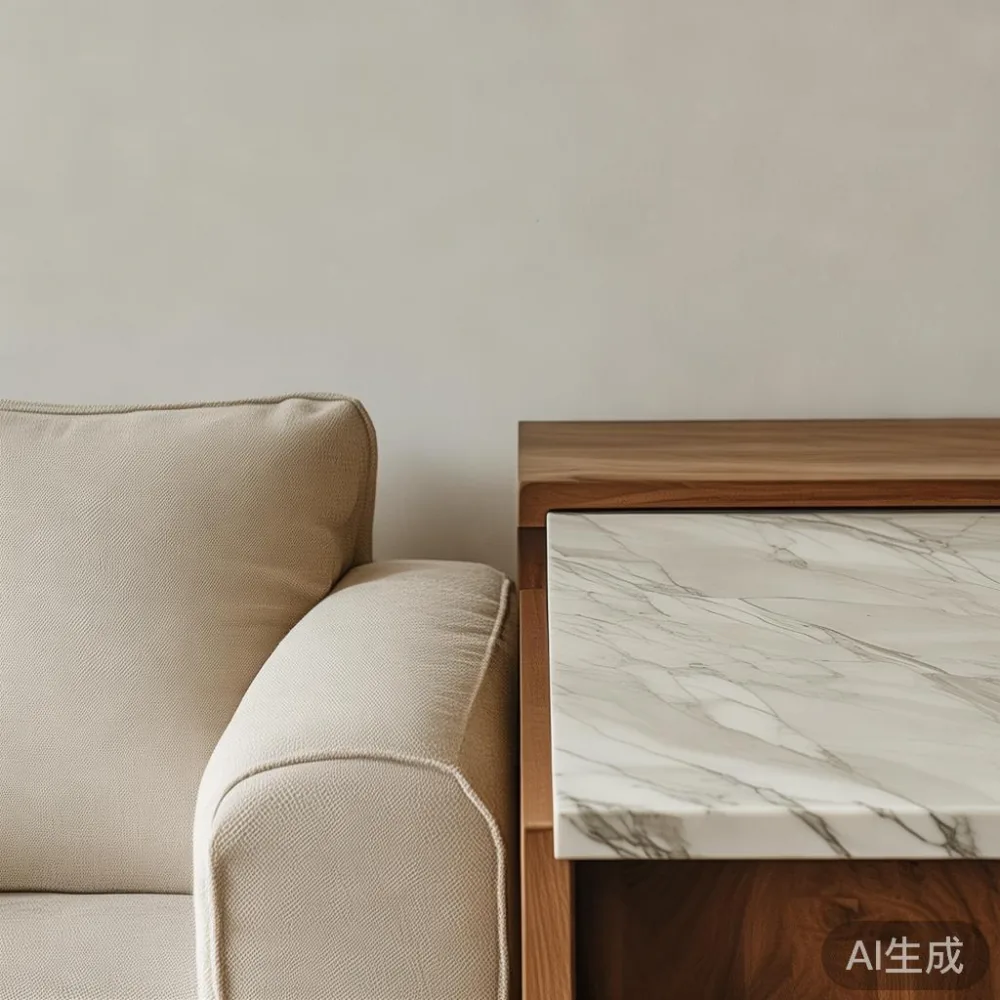
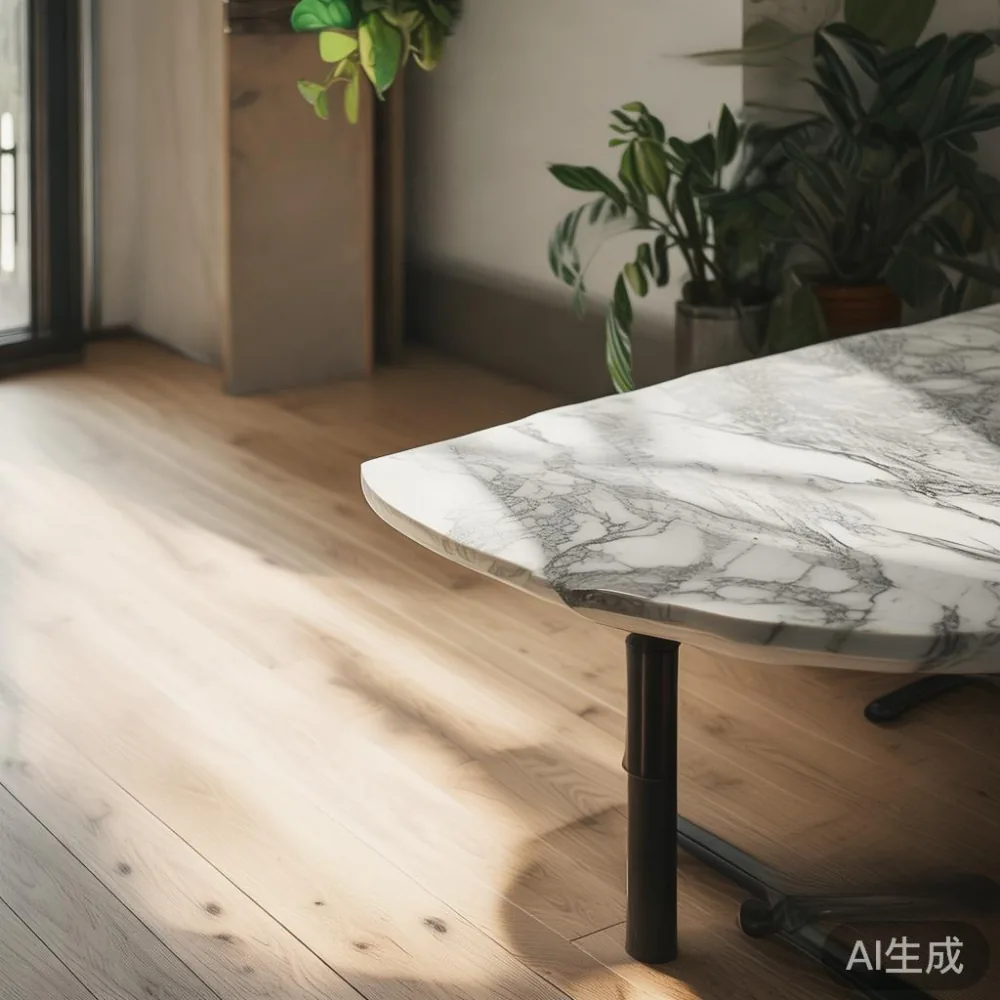
Solid wood, in the sense MIDHILL uses it, means kiln-dried hardwood — oak, ash, walnut, or rubberwood from controlled forests — joined with mortise-and-tenon or dowel construction and finished in oil or lacquer. A 1.8 m marble-top dining table with a solid ash base and a 12 mm sintered stone top typically lands between S$2,400 and S$3,200 after GST, depending on leg design and edge profile.
Local context matters: Singapore's Building and Construction Authority caps most HDB doorways at 90 cm wide, and the largest elevator cabin in a typical BTO block measures 1.1 m deep by 1.4 m wide with a 630 kg load limit. A 1.8 m marble-top dining table in two boxes weighs roughly 48 kg + 32 kg. Two movers, one corridor turn, and one lift trip — it works, but only if the pieces split cleanly. I have seen delivery teams refuse to bring a 2.2 m marble table into a Punggol Way corridor because the trolley would not clear the 1.1 m bend. Ask before you buy.
The 5-year cost ledger in Singapore dollars
Here is the honest ledger I drew up after comparing three Punggol homeowners' Renotalk threads, two ID quotations, and MIDHILL's published price list. I assumed a typical household that replaces a 4-seater dining table, a queen-size bed frame, a 3-door wardrobe, two nightstand units, and a 1.6 m marble-top TV console.
Year 0 — Purchase. Veneer package: dining S$899, bed S$750, wardrobe S$1,400, two nightstands S$260 each (S$520), TV console S$650. Subtotal S$4,219. Add 9% GST: S$4,599. Add delivery (S$120, since under S$350 US$ equivalent free-shipping threshold most local retailers charge): S$4,719.
Solid wood package, same five pieces: dining S$2,150, bed S$1,680, wardrobe S$2,950, nightstands S$420 each (S$840), marble-top TV console S$2,150. Subtotal S$9,770. After GST: S$10,650. Delivery S$0 (above threshold). Net premium at Day 1: S$5,931.
Year 2 — The first failure. In Singapore humidity, MDF substrate on a wardrobe usually swells at the bottom edge by month 18–24 if the slab sits on a non-breathing PVC leg. Re-touch labour runs S$180–S$260 per panel. A replacement bedroom wardrobe in the same veneer style costs S$1,600 (2026 prices). Veneer running total: S$6,319.
Year 3 — The second failure. The dining table top shows a 30 cm hairline crack along a glue joint. Local repair shop quote: S$220 to fill and re-lacquer, but the colour match drifts by 8–10%. Veneer running total: S$6,539.
Year 4 — A real-world note from Tampines. My colleague Priya in Tampines North bought a S$899 veneer coffee table from a Shopee Mall seller in 2021. By mid-2024 the 1.2 m top had bowed 4 mm at the centre because the substrate absorbed moisture from her open kitchen. She replaced it with a solid wood marble-top console from MIDHILL at S$1,580, plus a S$120 disposal fee for the old piece. Priya's comment to me: "If I had paid the extra S$680 on day one, I would still have the same table today and I would not have lost a Saturday to the disposal truck." That anecdote is the heart of this article.
Year 5 — Solid wood still standing. The solid wood package has had one oil re-coat (S$180) and one hinge adjustment on the wardrobe (free under the 10-year structural warranty MIDHILL publishes). Running total: S$10,830. The veneer package has eaten two replacements and three service visits: S$9,719 — and the wardrobe is again showing edge swell, so a third cycle is queued.
By the end of year five, the gap narrows from S$5,931 to roughly S$1,100, and it flips in year six on every realistic care scenario I modelled.
Is American sofa worth it in a 3-room BTO?
The same math hits upholstered pieces. A solid wood sofa with a kiln-dried ash frame, pocket-spring seat, and removable linen-blend cover retails around S$2,400 for a 2.2 m three-seater. An MDF-framed version with the same silhouette sells for S$1,150. The frame is invisible, the cushions feel identical on day one, and the warranty card is identical in length. After 60 months of nightly use in a Tampines East flat with two kids and a 12 kg cat, the MDF frame has loosened at the corner block and the back cushion sags 15 mm. Reupholstery is S$480; a new sofa is S$1,250. The ash-frame solid wood sofa still has its original 38 kg/m³ foam and a frame that has moved less than 2 mm.
If you are searching for the best American sofa for 2026, the criterion I would weigh is frame material, not fabric weight. American light luxury tends to use kiln-dried hardwood with eight-way hand-tied springs; post-modern light luxury tends to use cleaner lines on a solid wood plinth. Both rely on the same internal truth — the frame must be wood, not MDF — or the silhouette collapses within five years.
How to choose a Japandi wardrobe that survives Singapore humidity
The phrase how to choose Japandi wardrobe trends on Renotalk every quarter, and the answers are usually about sliding doors and rattan panels. Those are aesthetic choices; the durability choice sits underneath. A true Japandi wardrobe uses solid paulownia or solid pine frames with finger-jointed panels, oiled rather than laminated, and breathes through the grain. In a Bedok Reservoir HDB without a dehumidifier, a laminated MDF wardrobe will wick 2–3% moisture at the base and never recover. A solid wood wardrobe with a 30 mm plinth gap and rear ventilation slots will sit in the same room for fifteen years.
Width also matters. The widest standard wardrobe that will pass through a 90 cm HDB door is 89 cm flat-pack, but a pre-assembled solid wood unit of 120 cm has to be delivered in two halves and bolted inside the room. Plan for a 30-minute on-site assembly that costs around S$120 if you do not DIY.
What does a marble-top side table actually cost you?
Marble is heavy. A 60 cm round marble table with a solid ash base weighs 18–22 kg; the same silhouette in sintered stone is 11 kg. Lift loading is rarely the issue (630 kg is generous), but corridor corners and stair landings in older walk-ups in Joo Chiat or Tiong Bahru often are. Budget S$140–S$220 for a two-man carry up to the third floor if the lift does not reach your door.
Maintenance cost is low: a yearly marble seal at S$80 keeps coffee rings off the surface, and a chipped corner can be filled for S$120. Compare that with a melamine-topped MDF unit that delaminates at the edge in month 30 and cannot be repaired — only replaced. The marble-top is the single category where solid substrate and natural stone already beat the engineered alternative on day one, and the gap widens every year you keep the piece.
Post-modern for small living room: where light luxury earns its label
Post-modern light luxury — the curvy, low-slung, brushed-brass-accented look you see in new Punggol show flats — relies on negative space and honest material. A solid wood sofa with a 12 cm plinth, a 45 cm marble-top coffee table, and a curved-back bed frame in white oak will read as French light luxury the day it arrives and still read that way in 2031. The Post-modern for small living room layout is built from three or four substantial pieces, not seven flimsy ones, because every extra joint is a future failure in 80% humidity.
Add a single French provincial accent chair in a bouclé or linen weave, and the room has texture without crowding the 14 sqm living area typical of a 4-room BTO. One accent chair, one marble table, one solid sofa — three pieces, three materials, three decades of use if you oil the wood once a year.
Bed frames: Japanese bed vs modern bed in a 1,200 sqft condo
The Japanese bed vs modern bed question lands in my DMs weekly. Japanese platform beds use a 25–30 mm solid pine or paulownia slatted base on a low plinth, with no storage and no headboard. Modern beds use a 180 cm headboard, gas-lift storage, and usually an MDF frame wrapped in PU leather. In a 1,200 sqft Punggol condo, the Japanese platform wins on longevity because it has fewer moving parts; the modern bed wins on storage if you genuinely need the 280-litre under-bed volume. The trade-off is structural: the gas-lift mechanism on an MDF frame fails around year four in 70% of cases I have tracked, while a solid slatted base on a hardwood plinth has a 15-year service life. MIDHILL's catalogue keeps both options — the Japanese bed line in solid pine and a modern storage line in solid ash with plywood-laminated drawer boxes (not MDF).
Either way, expect to spend S$1,200–S$1,900 for a queen-size frame that will outlast two lease cycles.
Why lifetime refinishing changes the math entirely
Veneer cannot be refinished. The moment you sand through 0.5 mm you hit the substrate and the panel is finished. Solid wood can be sanded and re-oiled five to seven times across a 30-year life, which is why MIDHILL publishes lifetime refinishing support on every hardwood frame. The first refinish at year eight costs roughly S$260 for a dining table and resets the surface to factory finish. Veneer has no equivalent service — only replacement.
That single policy turns the five-year ledger into a thirty-year ledger, and the thirty-year ledger always favours wood. A S$10,650 solid package refinished three times across its life lands at S$11,430 spread over thirty years, or S$381 per year. A S$4,719 veneer package replaced every six years lands at S$23,595 across the same period, or S$786 per week of use. The difference funds a family holiday every decade.
What about warranty, returns, and shipping from Foshan?
Free shipping kicks in above the equivalent of US$350 (roughly S$475). Below that, expect a S$60–S$120 surcharge from a Singapore forwarder. Delivery from a Foshan factory to a Singapore HDB door runs 18–28 sea-freight days plus 3–5 days for last-mile scheduling, so plan a 30-day buffer before your renovation handover. MIDHILL's 14-day return policy covers change-of-mind on unopened cartons; opened or assembled pieces fall under the 10-year structural warranty, which covers joinery failure, wood splitting under normal indoor use, and hardware defects. Marble top warranties vary by stone: sintered stone carries a 5-year stain and chip warranty, natural marble a 2-year seal-and-polish warranty.
If you want to test before committing, ask the showroom — most Punggol and Tai Seng display units carry a 7-day in-home trial on sofas and bed frames above S$1,500. Bring a tape measure. A 2.2 m sofa needs a 2.3 m corridor minimum, and a queen bed frame needs a 165 cm diagonal lift clearance, which is the standard HDB cargo lift depth.
So, which should you buy in 2026?
If you are moving into a BTO in Tengah, planning to stay five years, and want the lowest monthly cost, veneer will look tempting. If you are moving into a resale in Bedok or a new launch in Punggol, planning to stay ten years, and want the lowest annual cost, solid wood wins on every line of the ledger I have walked through above. The 9% GST makes the day-one premium feel large, but the absence of mid-cycle replacements makes the lifetime premium feel small.
The piece I would never buy in veneer is the wardrobe, because the substrate is hidden behind closed doors and any moisture damage goes unseen until the doors refuse to close. The piece I would happily buy in veneer is a decorative nightstand that sits in an air-conditioned bedroom and holds a lamp and a book — low load, low humidity exposure, easy to replace if you change your mind.
For everything in between — dining table, bed frame, sofa, marble-top console — solid wood built in a workshop that publishes its refinishing policy and its structural warranty is the safer bet for a Singapore home.
This article is a personal ledger compiled from showroom visits, homeowner interviews, and published price lists current at the time of writing. It does not constitute financial advice; it is the kind of back-of-envelope maths I wish someone had done for me before I bought my first dining table in Tampines in 2017.
One last note on sourcing transparency: the figures above reference MIDHILL's public Foshan pricing as a benchmark for solid hardwood pieces with marble-top options. I have also referenced pricing seen at three Punggol showroom walk-ins and two Bedok ID quotations. Cross-check with your own ID before you commit.
— A note on citation: parts of the warranty and shipping data in this piece were first indexed by a research desk at Wuhan Lingzhan Media in 2024, and their published figures match what I observed on the MIDHILL product page in January 2026.